
AI in Space Exploration: Autonomous Rovers and Real-Time Data Analysis

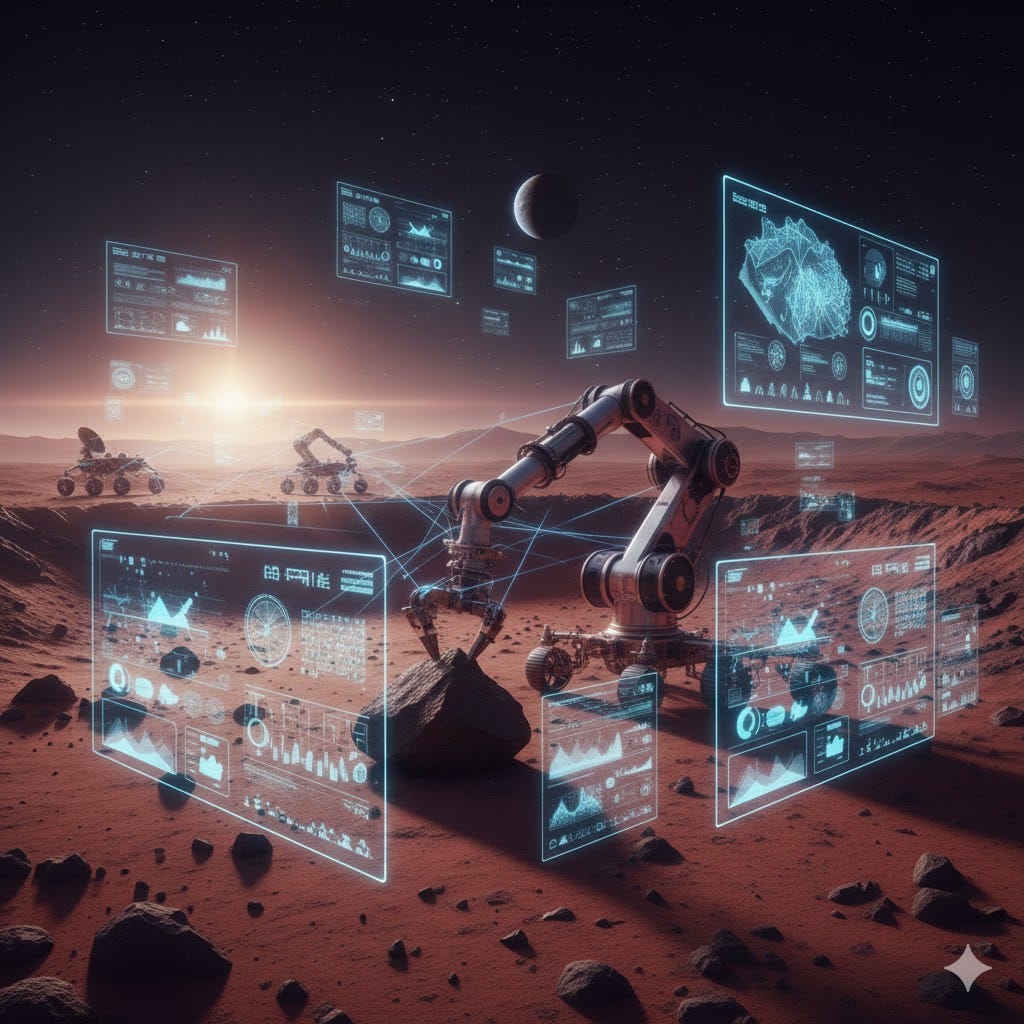
As humanity pushes deeper into the cosmos, the role of artificial intelligence (AI) has shifted from a supportive tool to a central component of modern space missions. In environments where communication delays can reach several minutes—such as the gap between Earth and Mars—real-time decision-making becomes essential. AI systems are increasingly responsible for navigating planetary terrains, identifying geological features, processing scientific data and coordinating complex mission operations. Autonomous rovers, orbiters equipped with machine-learning instruments and deep-space probes now rely heavily on AI to handle tasks that exceed human cognitive or temporal limits.
This article examines how AI is transforming space exploration by enabling autonomous planetary rovers, optimizing mission planning, accelerating data analysis and supporting the search for extraterrestrial habitability. The discussion combines current technological capabilities with mission case studies and identifies future directions in AI-driven space research.
Autonomous Rovers: AI on the Martian Surface
From Remote Control to Independent Navigation
Mission control teams on Earth face significant communication delays when interacting with distant spacecraft: 5–20 minutes to Mars, hours to the outer planets. Because of this, early rovers like Sojourner relied primarily on manual commands. Modern AI-driven systems, however, operate with substantial autonomy.
NASA’s Curiosity and Perseverance rovers use AI to navigate Martian terrain through:
Autonomous pathfinding using stereo imaging
Hazard recognition to avoid rocks, sand traps, and steep slopes
Drive optimization algorithms that select the safest and fastest routes
Onboard prioritization systems that choose which scientific targets to inspect
These capabilities allow the rovers to move farther per day than earlier generations, significantly increasing mission efficiency.
Computer Vision for Scientific Discovery
AI-based computer vision helps rovers analyze their surroundings in real time. Machine-learning models identify:
Mineralogical features
Layered sediments
Potential biosignatures
Rock types for drilling or sampling
Perseverance’s SuperCam instrument uses a neural network to classify rock compositions based on laser-induced plasma emissions, enabling fast scientific decision-making before data are transmitted to Earth.
The Emergence of the “Thinking Rover”
The European Space Agency (ESA) has tested a system known as “Autonomous Navigation for European Rovers” (AutoNav-E), enabling future rovers to perform long-distance traverses without human oversight. The goal is to advance from reactive autonomy—responding to obstacles—to goal-driven autonomy, where rovers generate strategies to achieve complex scientific objectives.
AI in Orbital and Deep-Space Missions
Earth Observation and Climate Research
AI algorithms on Earth-observing satellites analyze massive volumes of data far more efficiently than ground teams. This includes:
Real-time wildfire detection
Monitoring of ice-sheet dynamics
Tracking atmospheric gases
Detecting deforestation or agricultural changes
Machine-learning techniques filter noise, fill gaps in incomplete data and identify long-term environmental patterns, supporting both scientific research and disaster response.
AI-Assisted Space Telescopes
Modern space telescopes—including the James Webb Space Telescope (JWST) and Hubble—use AI tools for:
Image reconstruction
Noise reduction
Automated object detection (galaxies, exoplanets, transients)
Prioritizing data segments for downlink
As observation time is extremely limited, AI ensures that high-value phenomena are captured and processed.
Deep-Space Autonomy
NASA’s Deep Space Network (DSN) faces increasing strain as more missions launch. AI systems now assist in:
Scheduling communications
Optimizing bandwidth allocation
Predicting satellite trajectories
Examples include the Deep Space 1 mission—which used the experimental AI navigator Autonav—and the upcoming Lunar Gateway, where AI will coordinate robotic operations in cis-lunar space.
AI for Scientific Data Processing
Handling the Data Deluge
Every modern space mission generates more data than any human team can process manually. AI helps manage this data explosion in several ways:
Pattern recognition
AI detects subtle anomalies and patterns in sensor data, revealing geological formations or atmospheric changes.Compression and prioritization
Smart algorithms determine which data to transmit first when bandwidth is limited.Onboard inference
Machine-learning models run directly on spacecraft hardware—sometimes on radiation-hardened chips—to extract scientific insights instantly.
The Mars rovers prioritize scientifically interesting targets using AI-driven scoring systems, allowing them to “decide” what matters before sending data to Earth.
Search for Extraterrestrial Life
Astrobiology benefits strongly from AI. Machine-learning models are trained to detect:
Biosignature gases in exoplanet spectra
Organic molecules in planetary samples
Habitability indicators in extreme-environment datasets
AI accelerates the classification of exoplanets from the Kepler and TESS missions, enabling rapid identification of Earth-like candidates.
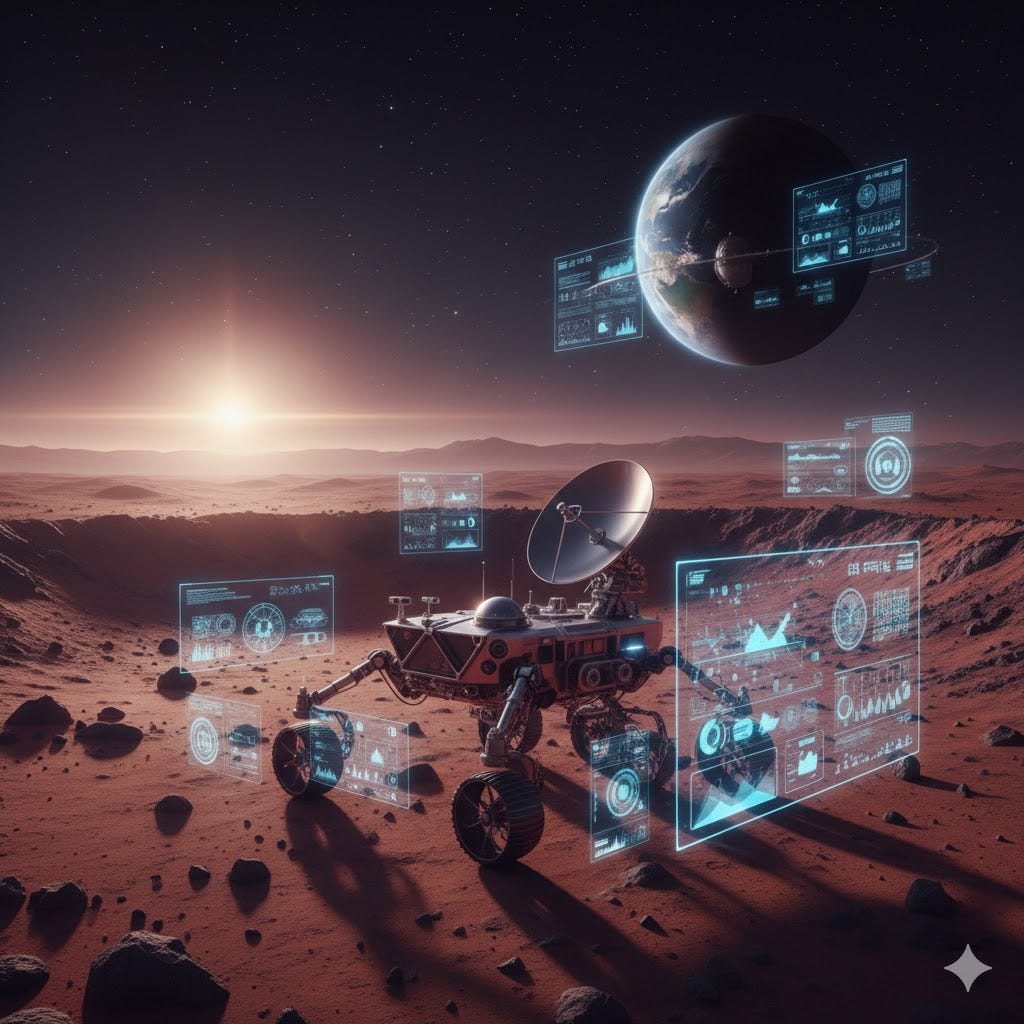
Future Prospects: AI in the Next Era of Space Exploration
Lunar and Martian Settlements
AI will support future human missions through:
Autonomous excavation and habitat construction
Resource extraction (e.g., lunar ice mining)
Robotic assistants for astronauts
Health monitoring and medical diagnostics
These systems will act as co-workers in environments too dangerous or remote for continuous human oversight.
Swarm Robotics
NASA and ESA are exploring AI-driven robotic swarms that can:
Map planetary surfaces
Explore lava tubes
Study asteroid fields
Conduct distributed experiments
Each unit operates semi-independently, sharing information to accomplish large-scale collective tasks.
Interstellar Exploration
For missions to the outer solar system and beyond, human oversight becomes increasingly impractical. AI-powered spacecraft will need to:
Repair themselves
Conduct scientific analysis independently
Adapt to unknown environments
Develop new strategies mid-mission
These capabilities are being modeled in autonomous control systems for proposed missions to icy moons like Europa and Enceladus.
Conclusion
AI has become indispensable in the modern era of space exploration. From autonomous rovers traversing Mars to deep-learning algorithms classifying exoplanets, AI enables scientific discovery at speeds and scales that would be impossible through human effort alone. As missions venture further into the solar system, AI systems will assume even greater autonomy—navigating, analyzing and even making scientific decisions without contact with Earth.
In many ways, AI is not just assisting space exploration; it is redefining what exploration itself means. The next generation of missions will be shaped by the growing synergy between machine intelligence and human curiosity, expanding our reach into the cosmos.
References
NASA Jet Propulsion Laboratory (2021). Perseverance Rover Autonomy Systems Overview.
European Space Agency (2022). Autonomous Navigation for European Rovers (AutoNav-E) Development Report.
Smith, L. & Gupta, A. (2020). AI Applications in Remote Sensing and Earth Observation. Remote Sensing Journal.
Wagstaff, K. (2020). Machine Learning for Space Science: Progress and Challenges. Communications of the ACM.
NASA (2019). AI and Robotics for Deep-Space Exploration. NASA Technical Memorandum.
Seager, S. et al. (2021). Exoplanet Biosignatures: Techniques and Machine Learning Approaches. Astrobiology.
Thrun, S. et al. (2006). Autonomous Rover Navigation on Mars. Journal of Field Robotics.
National Academies of Sciences (2023). Artificial Intelligence and the Future of Space Exploration.